How to become a drone pilot, from first question to first client
The FAA test is one step out of seven, and it's rarely the one that stops people. Below is the whole path in order, with what each step takes, what it costs, and the place most people stall.
Last reviewed
The short version
Plan on roughly 6 to 16 weeks from deciding to try this to a first paid job in a photo lane like real estate. Cash spent along the way, counting a drone, insurance and some business setup, usually lands somewhere around $1,100 to $3,000.
Both ranges are our estimate, built from the costs and timelines pilots report at each step below. If you already own a drone, or your employer is paying, your number will be much smaller.
Step 1: Decide what kind of drone work you want
- Time
- A few days to a couple of months
- Cost
- $0
Choose the work before you choose a drone. The people who earn steadily usually add drone flying to something they already do: a real estate photographer adds aerials, a roofer checks roofs without a ladder, a landscaper fills the slow months.
Pay depends heavily on the work. PhotoUp's 2026 guide puts a real estate drone package at $150 to $400 per property, with a median around $225. For full-time jobs, Indeed's drone pilot salary page shows a range of about $44,000 to $152,000 a year, drawn from 258 job postings.
Check that you actually need the license, too. If the flight helps a business in any way, paid or not, the answer is almost always yes.
Where people stall
"The market is flooded" posts make people wonder whether they are making a mistake before they start.
How to get past it
Some corners really are crowded, especially basic real estate photos in big cities. Take the quiz, then look for work near you that is less crowded, like roofs, construction progress or farms, and lean on whatever skill or trade you already have.
Free tools and guides for this step
Sources: PhotoUp 2026: $150-$400, median about $225; Indeed, updated 2026-09-04: $43,938-$151,582, 258 postings; FAA Recreational Flyers: compensation does not decide; "When in doubt, assume Part 107"
Step 2: Get your FAA Tracking Number in IACRA
- Time
- About 15 minutes
- Cost
- $0
IACRA is the FAA's online certification system. Creating a profile there gives you an FAA Tracking Number, or FTN, which you need before you can register for the test. It's also printed on your test report.
While you are at it, set up your account with PSI, the testing company. PSI now asks for an authenticator app when you create an account, so install one on your phone first.
Where people stall
Government sign-up screens are confusing, and people close the tab halfway through.
How to get past it
Do IACRA and PSI in one sitting with your photo ID beside you and the authenticator app already installed. Save your FTN somewhere you will find it on test day.
Free tools and guides for this step
Sources: FTN required before registering, printed on the test report (WEB-RP Step 1; ACS p. A-2)
Step 3: Study for the test
- Time
- Most people report 1 to 3 weeks; anywhere from 5 hours to 4 weeks
- Cost
- $0 to about $300, from free videos to paid courses
The test is 60 multiple-choice questions in 2 hours, and you need 70% to pass. PSI adds 5 unscored questions, and the time limit already allows for them.
PSI's current test bulletin weights regulations at 48% of the test, so the rules deserve most of your hours. Weather is 5%, but the METAR codes still catch people who skip them.
You get a printed chart supplement at the test center, so practice reading those figures. From October 26, 2026, the test also adds image questions taken from current sectional charts that are not in the supplement.
You don't need flight hours or your own drone to take the test.
Where people stall
Overwhelm. People start a long video course, feel buried after three lessons and stop, or they hit the weather section and lose a week.
How to get past it
Study one area at a time in short sessions and test yourself early. Take the free practice test to find your weak areas, then spend your time there instead of rewatching what you already know.
Free tools and guides for this step
Sources: 60 questions (ACS p. A-1); 2 hours (ACS p. A-1; CIB p. 4); 70% to pass (ACS p. A-2; 14 CFR 107.67(c)); multiple choice (ACS p. A-1); image questions from current VFR sectionals from October 26, 2026 (ATCA pp. 5-6); eligibility has no flight-hour or drone-ownership requirement (14 CFR 107.61)

Step 4: Book and take the test at PSI
- Time
- Half a day, plus travel; some people drive a long way to the nearest center
- Cost
- PSI sets the test fee and shows it when you book
Book online at faa.psiexams.com or by phone at 844-704-1487. No instructor sign-off is needed, even for a retake. You can take the test from age 14, though you have to be 16 to hold the certificate.
Bring a valid ID showing your photo, date of birth, signature and home address. Arrive at least 15 minutes early, and cancel or reschedule at least 24 hours ahead or you can lose the fee.
Phones, watches, wallets, pens and even shirts with pockets stay out of the testing room. The center hands you the supplement booklet, scratch paper and something to write with.
You get your test report as soon as you finish. A passing report is good for 24 calendar months for applying for your certificate. If you fail, you wait 14 days and bring the failed report when you retake.
Where people stall
Test-day nerves and the wording. People who knew the material say the way the questions were phrased is what got them.
How to get past it
Take at least two full timed mock exams before you book, so the clock and the phrasing are familiar. Read every answer option before choosing, because questions often hinge on one word.
Free tools and guides for this step
Sources: faa.psiexams.com, 844-704-1487 (ACS p. A-2; CIB p. 2); report on completion, valid 24 calendar months (ACS p. A-5); 14-day wait, bring failed report (14 CFR 107.71)
Step 5: Apply for your certificate
- Time
- Up to 48 hours for your test to show in IACRA, a few days to a week for the temporary certificate, about a month for the card
- Cost
- $0
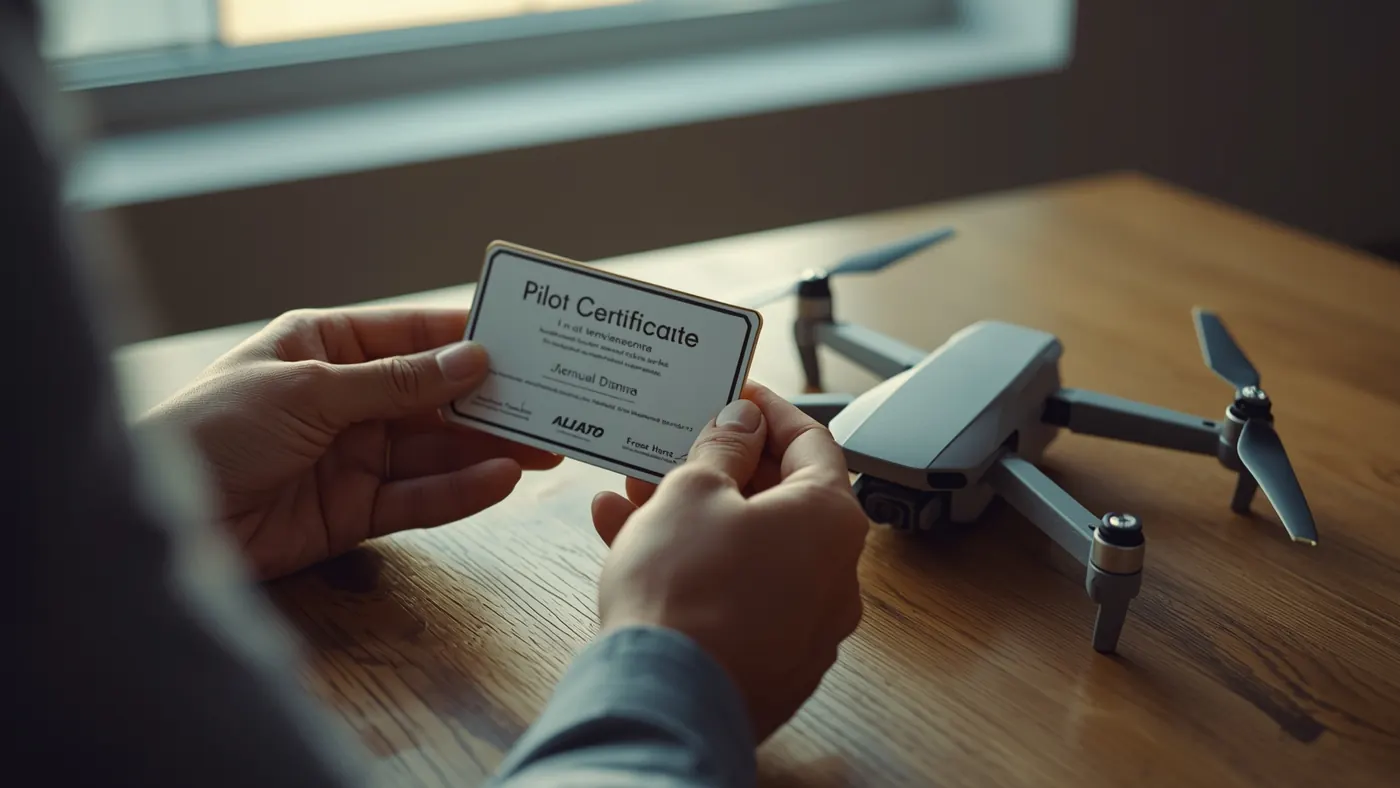
In IACRA, start a new application for a Remote Pilot certificate (FAA Form 8710-13), enter the 17-digit exam ID from your test report and sign. Your result can take up to 48 hours to appear there, so wait before you start.
The TSA runs a background check first. When it clears, IACRA emails you instructions to print a temporary certificate, which is valid for up to 120 days while the plastic card comes by mail.
While you fly under Part 107, carry your certificate and ID. To keep flying, you complete a free online recurrent course every 24 calendar months, counted to the end of the month.
Where people stall
"Can I do jobs with a temporary airman certificate?" People sit on their hands waiting for the card.
How to get past it
The temporary certificate is a real certificate for up to 120 days, so use the wait to register your drone, sort insurance and start practice flights.
Free tools and guides for this step
Sources: Form 8710-13 in IACRA, 17-digit exam ID (WEB-RP Step 4); up to 48 hours to appear (WEB-RP Step 4); TSA vetting, IACRA emails print instructions (AC p. 6-2); temporary certificate up to 120 calendar days (14 CFR 107.64); permanent certificate by mail (WEB-RP Step 6); carry certificate and ID (14 CFR 107.7(a))
Step 6: Register your drone, sort Remote ID and insurance, and practice
- Time
- About 15 minutes to register; 2 to 12 weeks of practice flying
- Cost
- Drone about $400 to $2,000+ for photo work; insurance about $500 to $1,000 a year for $1M liability, or on-demand cover around $5 to $15 an hour
Any drone you fly under Part 107 has to be registered for that use, and the registration lasts 3 years. The under-250-gram exemption only covers recreational flying, so a small drone used for a job still needs it. Put the registration number on the outside of the drone.
Your drone also has to meet Remote ID, either built in or through a broadcast module, unless you only fly inside an FAA-recognized identification area.
For insurance, insurers quote roughly $500 to $1,000 a year for $1 million in liability cover, and on-demand policies run about $5 to $15 an hour of flying.
Then fly. Practice somewhere open and away from people, and check the airspace first, because controlled airspace near airports needs an authorization even for practice.
Where people stall
Confusion about small drones and Remote ID, and people with a license who have never actually flown.
How to get past it
Treat every drone you use for work as needing registration and Remote ID, whatever it weighs. Then build stick time on simple moves, hovering, slow orbits and straight passes, over your own property before anyone is watching.
Free tools and guides for this step
Sources: drone $400-$2,000+; register 15 minutes; insurance $500-$1,000/yr or $5-15/hr per BWI and SkyWatch; practice 2-12 weeks; sub-250g confusion; registration required for Part 107 (14 CFR 107.13, 91.203(a)(2)); registration expires after 3 years (14 CFR 48.100(c)); 0.55 lb exception is recreational only (14 CFR 48.15(b)); number displayed on an external surface (14 CFR 48.205); Remote ID standard, broadcast module, or FRIA (14 CFR 89.101, 89.115); no flight over people outside the listed conditions (14 CFR 107.39); Class B, C, D and Class E surface areas need ATC authorization (14 CFR 107.41)
Step 7: Build a small portfolio, set your prices and find your first client
- Time
- 2 to 12 weeks to a first client; steady income often takes much longer
- Cost
- $0 to about $100 for outreach; $50 to $500 for business setup, depending on your state
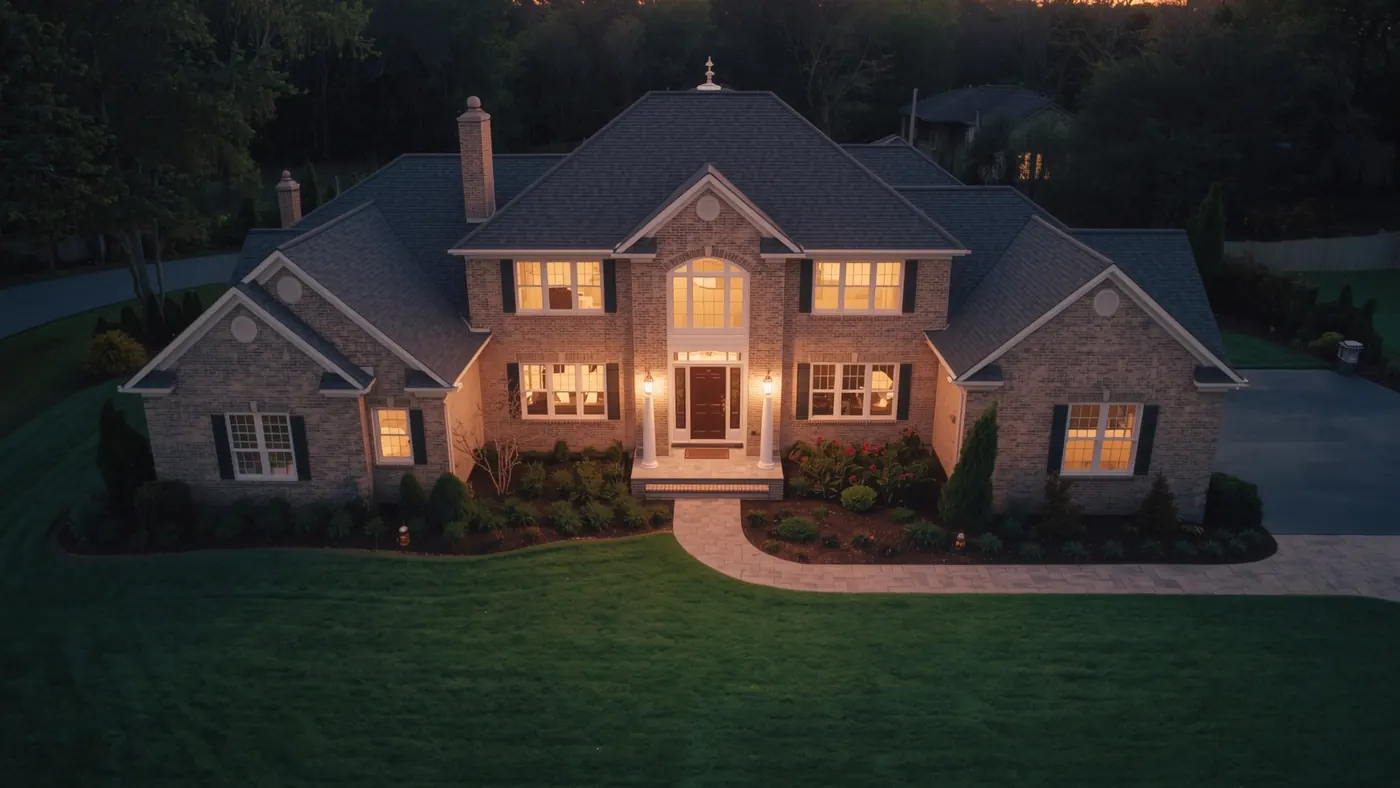
Shoot a handful of photos you're proud of before you pitch. One part-time pilot on r/RealEstatePhotography wrote that he practiced on his own house, waited until he had five shots he liked, then offered top local agents a free collaboration shoot and heard back from more than five of them.
Price from real ranges, and adjust for your town. One working pilot on r/Part107 shared typical rates of $150 to $400 for a roof and $500 to $2,000 a month for a construction retainer. Treat those as one person's rate card rather than what you will earn.
Set up the business side as you go: an LLC or DBA, any state or local license, and a plan for taxes. Costs run roughly $50 to $500 depending on the state.
Where people stall
Finding the first client is where the most people stall. "Where do you find the first clients?" gets asked in pilot forums several times a day.
How to get past it
Pick one kind of customer and message ten of them this week, like listing agents with homes on the market or roofers who still climb ladders. Lead with your five shots and a simple price, and follow up once.
Free tools and guides for this step
Free tools for each step
- Which drone job fits you?Match your life to a kind of drone work in a couple of minutes.
- Do I need a drone license?Free shoots, YouTube channels and work drones, answered plainly.
- Free practice test20 questions with a score for each area.
- Drone pricing calculatorWork out a price before a client asks.
- First Paid FlightWhat to do between passing and getting paid.
Questions about becoming a drone pilot
How long does it take to become a drone pilot?
Getting licensed usually takes a few weeks: one to three weeks of study for most people, a day for the test, then a few days to a week for a temporary certificate. Getting to a first paid job takes longer, roughly 6 to 16 weeks in total by our estimate.
How much does it cost to become a drone pilot?
The certificate application and recurrent training are free. PSI sets the test fee and shows it when you book. The bigger costs come after: a drone for photo work runs about $400 to $2,000+, and liability insurance about $500 to $1,000 a year.
Do I need to own a drone to get my license?
No. The FAA's eligibility rules don't require a drone or flight hours, and the test is a written knowledge test. You'll want one for practice before paid work.
How old do you have to be?
You can take the test at 14, and you need to be 16 to hold the Remote Pilot Certificate.
Do I need a license if I'm not getting paid?
Usually, yes. The FAA says compensation isn't what decides whether a flight is recreational, and it lists photos to help sell a property and roof inspections as flights that need Part 107. Only flying purely for fun is covered by the recreational exception.
Does the drone license expire?
To keep flying under Part 107, you complete free online recurrent training every 24 calendar months, counted to the end of the month.
Want steps 3 through 7 in one place?
Liftoff Pilot covers the test prep and then the work of finding paid jobs, for one payment.
Last reviewed . Liftoff is an independent study tool, not affiliated with the FAA.